.png)

When You Feel Responsible for Everyone Else’s Feelings

It can start quietly
I used to filter what I said.
Not always consciously… but enough to notice it.
Watching people’s reactions.
Noticing tone.
Trying, from the very beginning, not to cause offence.
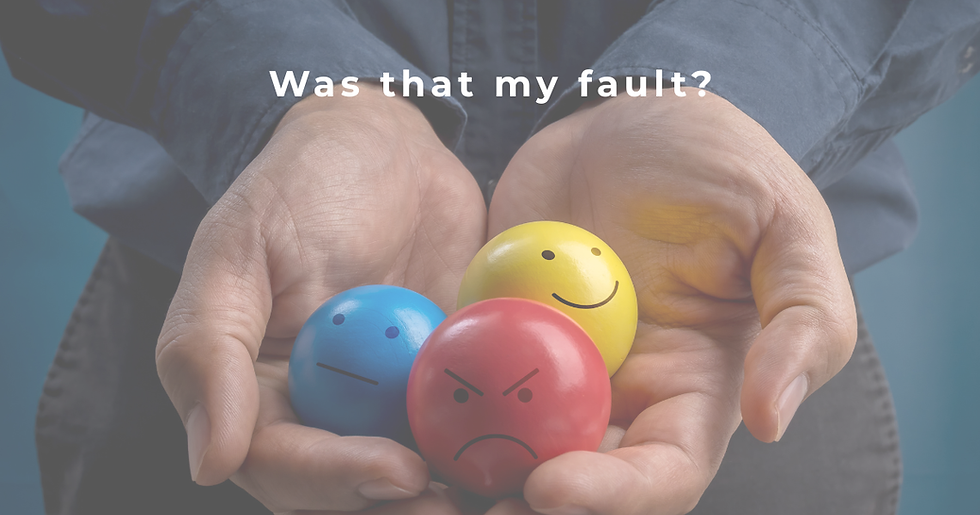
If someone seemed off, my mind would go straight to:
Was it me?
And then I’d go back over the conversation.
Replay it.
Pick it apart.
Fine-tune what I’d said.
Sometimes quietly criticising myself for getting it wrong.
I’m not someone who sets out to cause offence.
If anything, I go out of my way to avoid it.
That doesn’t mean I always get it right.
There have been moments where something I’ve said hasn’t landed as I intended.
And I’ve felt that.
What was underneath it
For me, this wasn’t random.
It was about keeping things smooth.
Keeping people happy.
Or at least not upsetting them.
Keeping the environment feeling safe.
Because when someone is upset, it can feel risky.
Like I’ve done something wrong.
Like I’ve hurt someone.
Like I’ll be judged… talked about… rejected.
Or worse.
That something might come back at me emotionally… or personally.
So I became someone who noticed.
The smoother-over.
The anticipator.
Trying to read what might happen before it did.
How it plays out
And when someone was upset?
I would notice it.
Especially if I was hosting or in a setting where I felt responsible for the atmosphere.
That’s a natural thing.
But for me, it didn’t always stop there.
It would stay with me…and become something I felt responsible for.
Even now, I still care.
I still want to respond in a decent, thoughtful way.
Being polite and considerate has always felt natural to me.
The difficulty came when it stopped being a choice…and started feeling like something I had to do to keep things okay.
I’ve come to see there’s a difference between caring… and taking responsibility.
Caring is being present.
Taking responsibility is feeling like it’s mine to fix.
And over time, something else happens.
You start to lose your place in it all.
Losing your place in it
For me, that realisation didn’t fully land until my 50s.
That somewhere along the way, I’d lost a clear sense of who I was.
My thoughts had become… merged.
Influenced.
Shaped around what kept things calm rather than what felt true.
There were moments of resentment.
Moments of feeling subdued.
And underneath it all, a quiet belief:
Others are probably right.
And I’m probably wrong… or at least, that’s how it felt at the time.
And when that’s running in the background, your own voice doesn’t get much space.
Not because it isn’t there.
But because it hasn’t been given room… or permission.
Even now, I notice it in certain relationships.
I don’t show up in the same way everywhere.
In some places, I’ve learned to be more open… more direct.
In others, I still find myself being more cautious… more measured.
And where trust doesn’t feel secure, something in me holds back.
So it’s not about being one way.
It adapts, depending on the relationship… and what feels safe.
It isn’t always one clear pattern.
Most of us move along a spectrum.
In some situations, we’re more grounded… more able to speak freely.
In others, something in us still adapts… softens… holds back.
It can depend on the relationship… the history… what feels safe in that moment.
When something begins to change
Something began to shift when I realised I couldn’t keep going like that.
That constantly adapting, smoothing, merging… came at a cost.
To energy.
To clarity.
To a sense of self.
Stepping back from that felt strange.
Unfamiliar.
But I started to see things differently.
That sometimes, people’s behaviour isn’t about me.
That sometimes, patterns between people continue… because they’ve been allowed to.
And perhaps most importantly:
I’ve come to realise that I can’t be responsible for how someone else feels.
A moment that stayed with me
I remember a moment that brought this home for me.
I was asked to do something for someone who had a history of being difficult with me.
In the past, I would have done it.
Out of duty.
Out of keeping the peace.
Even if I didn’t want to.
But this time, I said no.
I won’t. I can’t. I’m sorry.
And yes, afterwards there was guilt.
That familiar feeling.
But I sat with it.
Because if I keep you happy… and them happy…
what happens to me?
That question mattered more.
What I’m learning now
I’m still a work in progress with this.
But something has changed.
There are moments now where my body almost says no before my mind catches up.
And I follow it.
Even if it feels uncomfortable afterwards.
Because not taking responsibility for everything doesn’t mean I stop caring.
It means I’m beginning to recognise what’s actually mine.
And what was never mine to begin with.
Other people’s feelings come from:
their thoughts
their experiences
their expectations
their own internal world
I can influence a moment.
But I am not responsible for how someone processes it.
And when I step back from rescuing, something else happens.
People begin to meet themselves.
To deal with their own triggers.
To take responsibility in their own way.
And I get something back too.
A little more space.
A little more energy.
A little more of myself.
If this feels familiar
You don’t need to change everything at once.
Start with awareness.
Notice what you do.
Notice what it costs.
Notice how much energy it takes.
And gently begin to ask:
Is this mine to carry?
Because over time, something important becomes possible.
Not perfect relationships.
But more honest ones.
Not a fixed version of you.
But a more real one.
And that changes everything.
Even if it doesn’t feel like it at first.
And maybe that’s where it begins… not changing everything, but putting down what was never yours to carry.
If this resonated, you’re welcome to subscribe for more reflections like this
I also share a free guide and workbook if you’d like to start exploring this further.





Comments